


Technical Artistry and the Garden City: A Biographical Analysis of John Vincent Lawless Hogan
The narrative of American technological progress in the twentieth century is frequently dominated by the figures of the “lonely inventor” or the “corporate titan.” Yet, a more nuanced examination of the history of telecommunications reveals a critical third category: the professional engineer-idealist. John Vincent Lawless Hogan represents the pinnacle of this archetype. Throughout a career that spanned more than half a century, Hogan functioned as a bridge between the erratic, spark-gap era of wireless telegraphy and the sophisticated, high-fidelity landscape of modern broadcasting. His biography is not merely a list of patents and institutional foundations; it is a study in the application of rigorous scientific methodology to a medium that was, in its infancy, often treated as a form of magic or a speculative fad. Central to his personal and professional equilibrium was his long-term residency in Forest Hills Gardens, a community whose planned order and intellectual density provided the necessary environment for his most significant innovations.
John Vincent Lawless Hogan was born on February 14, 1890, in Philadelphia, Pennsylvania, a city that was then a hub of industrial engineering and scientific inquiry. His entry into the field of wireless communication occurred with startling precocity. At the age of twelve, in 1902, Hogan constructed his first amateur wireless station, utilizing a coherer detector to intercept maritime and experimental messages populating the Philadelphia airwaves.
The professionalization of Hogan’s interests began in 1906 when he secured a position as a laboratory assistant to Dr. Lee de Forest, who was then embroiled in the foundational developments of the vacuum tube. In March 1907, Hogan served as an assistant during the first public demonstration of the audion (triode) at the Brooklyn Institute of Arts and Sciences—an event widely cited as the birth of modern electronics.¹ While de Forest was often criticized for lacking a complete physical understanding of his invention, Hogan provided a vital analytical counterweight by conducting the first quantitative study of the grid triode’s plate current characteristics, translating intuitive leaps into the standardized language of electrical engineering.¹
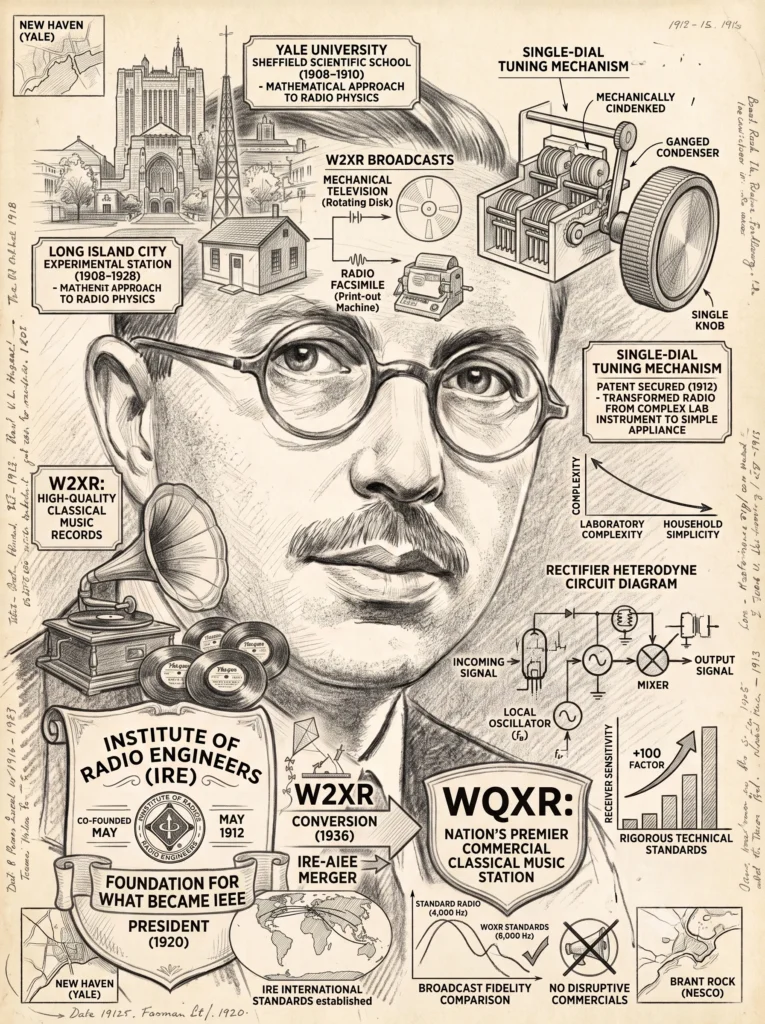
Hogan’s academic tenure at the Sheffield Scientific School of Yale University from 1908 to 1910 further solidified his commitment to theoretical rigor. Focusing on physics, mathematics, and electric waves, Hogan began publishing scholarly papers as an undergraduate, including his 1909 study “Inductance Coils Used in Wireless Telegraphy” published in Electrical World.² Though he left Yale before graduating to join Reginald Fessenden’s National Electric Signaling Company (NESCO), his formal scientific training shaped every subsequent stage of his career.
Working at NESCO’s legendary Brant Rock station in Massachusetts starting in 1910, Hogan helped make radio a reliable medium for long-distance communication. In 1912, he secured a patent for the single-dial tuning system, mechanically linking variable components so a user could sweep frequencies with a single control—a key development that allowed radio to move from hobbyist workbenches into consumer living rooms.³ In 1913, Hogan achieved a major breakthrough by demonstrating the “rectifier heterodyne,” combining a received signal with a locally generated frequency to increase receiver sensitivity by a factor of 100 (102), making transoceanic circuits viable.³
Recognizing that the fractured wireless field lacked a unified professional body, Hogan collaborated with Robert H. Marriott and Alfred N. Goldsmith in May 1912 to merge existing societies into the Institute of Radio Engineers (IRE).⁴ Hogan served as vice-president (1916–1919) and president (1920), helping establish international engineering standards for the organization that eventually became the modern IEEE.⁴
As Hogan’s reputation grew, he sought a residential environment that provided the intellectual quietude necessary for his research. In the early 1920s, he moved to Forest Hills, Queens, initially residing at 307 Burns Street before constructing his permanent home at 239 Greenway South in Forest Hills Gardens in 1925.⁵ Designed by architect Grosvenor Atterbury and landscape architect Frederick Law Olmsted Jr. for the Russell Sage Foundation, Forest Hills Gardens was a 175-acre planned community modeled after British “garden cities.”⁶ With its winding streets, Tudor architecture, and strict covenants, it offered Hogan a sanctuary of intellectual order and a network of elite neighbors, including sculptor Adolph Alexander Weinman and author Homer Croy.⁷ Hogan became an active civic leader, participating regularly at the Forest Hills Community House in the early 1930s and lecturing for the Gardens Association, the historical precursor of The Forest Hills Gardens Foundation.⁸
Living in the Gardens provided the psychological tranquility and physical space Hogan needed for his experimental enterprises. In 1928, he began operating experimental station W2XR from Long Island City to test mechanical television and radio facsimile broadcasts. To accompany his visual tests, Hogan broadcast high-quality classical music records. Realizing that listeners were tuning in specifically for the audio fidelity, Hogan and Elliott Sanger co-founded the Interstate Broadcasting Company in 1936, converting W2XR into WQXR—the nation’s premier commercial classical music station.⁹ Hogan enforced rigorous technical standards, expanding audio frequency response to 8,000 Hz and banning disruptive commercials to prove radio could be a dignified public service.⁹
WQXR’s audio fidelity caught the attention of FM radio pioneer Edwin Howard Armstrong, who used the station’s signals as primary source material for his wide-band FM experiments. Hogan embraced the new technology himself, launching experimental FM station W2XQR in 1939. In 1944, The New York Times purchased WQXR, retaining Hogan as technical director.⁹ Concurrently, Hogan advanced radio facsimile technology, developing systems capable of printing home “radio newspapers” at 500 words per minute and creating the “Times Facsimile” for wire photo transmissions.
During World War II, Hogan served as a special assistant to Vannevar Bush at the Office of Scientific Research and Development (OSRD). His expertise in signal processing and miniaturization proved critical to the mass production of the proximity fuze—a miniature radar circuit built into artillery shells.¹⁰ In 1956, Hogan was awarded the IRE Medal of Honor in recognition of his lifetime of inventions and institutional leadership.⁴
John Vincent Lawless Hogan died on December 29, 1960, at his home at 239 Greenway South after a long illness, concluding a thirty-five-year association with Forest Hills Gardens.¹ His home stands as a quiet monument to an integrated life where technical innovation, aesthetic beauty, and community citizenship converged. Hogan demonstrated that technology reaches its highest expression when guided by precision, quiet discipline, and a commitment to public service.
Sources
[1] “John Hogan, Radio Expert, Dies; Co-Founder of WQXR Was 71,” New York Times, December 30, 1960.
[2] John V. L. Hogan, The Outline of Radio (Boston: Little, Brown and Co., 1923), 45–82.
[3] John V. L. Hogan, “The Heterodyne Receiving System, and Notes on the Recent Arlington-Salem Tests,” Proceedings of the Institute of Radio Engineers 1, no. 3 (July 1913): 75–91.
[4] Institute of Radio Engineers, “Recipients of the IRE Medal of Honor: John V. L. Hogan,” Proceedings of the IRE44, no. 4 (April 1956): 450–452.
[5] Queens County Registrar, Property Deed and Land Assessment Records for 239 Greenway South, Block 12, 1924–1926 (Long Island City: Queens Borough Public Library, Long Island Division), property map series 4.
[6] Susan Klaus, A Modern Arcadia: Frederick Law Olmsted Jr. and the Plan for Forest Hills Gardens (Amherst: University of Massachusetts Press, 2002), 48–56.
[7] Forest Hills Gardens Foundation, The Maps and Famous Residents of Forest Hills Gardens, 1913–1930 (Forest Hills, NY: Forest Hills Gardens Foundation Archive, 2016), 1–8.
[8] “Radio Pioneer Speaks at Community House: J. V. L. Hogan Explains Wireless Science to Neighbors,” The Daily Star (Queens), May 14, 1924, 4.
[9] Elliott Sanger, Rebel in Radio: The Story of WQXR (New York: Hastings House, 1973), 15–38.
[10] Office of Scientific Research and Development, Administrative History of OSRD Division 4: Ordnance Accessories and the Proximity Fuze (Washington, DC: National Academies Press, 1948), 102–115.