Theodore Roosevelt in Forest Hills Gardens: July 4, 1917
by Ann Chamberlain
In the early summer of 1917—the momentous year the United States entered World War I—Colonel Theodore Roosevelt, the 26th President of the United States (1901–1909), received over 500 invitations from across the nation to speak on the Fourth of July.
Over the years, I had often wondered how it came to be that Forest Hills was the single location he chose. In the course of my work and research as co-Chair of the Forest Hills Gardens Foundation (FHGF) Archive Committee, with a particular focus on the Forest Hills Gardens Bulletins from 1916 and 1917, the answer became clear. Station Square in Forest Hills Gardens was, without a doubt, the perfect venue.
A Lifelong New York Connection
Theodore Roosevelt (“TR” was his favorite nickname, not Teddy with its bear connections) was a New Yorker through and through, deeply respected in his home state. Born in Manhattan in 1858, he served as a New York State Assemblyman (1882–1884), President of the Board of Police Commissioners for New York City (1895–1897), and Governor of the State (1898–1900). He built Sagamore Hill, his beloved home in Cove Neck, Long Island, where he and his family lived from 1885 until his death in 1919. Located in western Nassau County, Sagamore Hill made the trip to the Gardens an easy one.
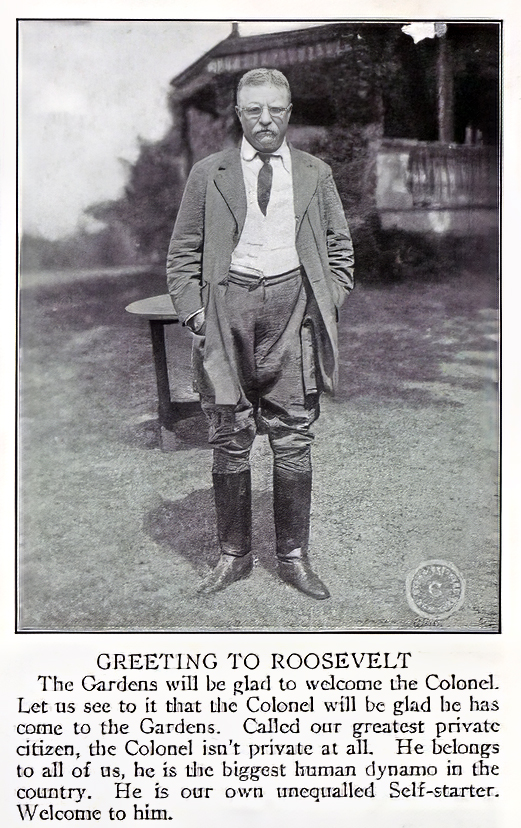
The community extended an enthusiastic welcome to the former president in the days leading up to his historic visit.
A Sunday Connection
TR was a steadfast churchgoer. His habit was to attend services every Sunday, and although he was a lifelong member of the Dutch Reformed Church, he often attended services with his wife, Edith, a devout Episcopalian.
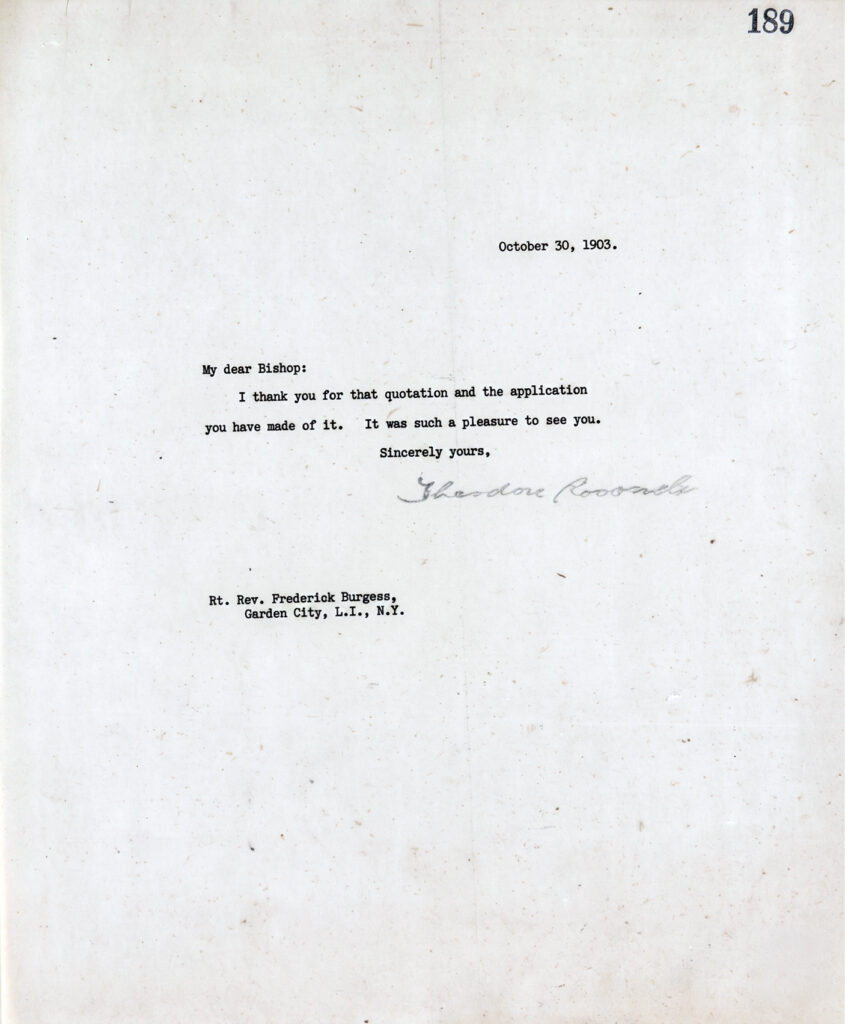
The Rt. Rev. Frederick Burgess, who would introduce TR in the Square in 1917, served as the Bishop of the Episcopal Diocese of Long Island from 1901 to 1925 and presided over the Cathedral of the Incarnation in Garden City—not far from Sagamore Hill. TR and the Bishop were close friends. As early as 1903, then-President Roosevelt sent a note to the Bishop thanking him “for the quotation and the way it was used.” In 1907, TR sent a similar note congratulating the Bishop on a recent sermon.
TR Letter to Rt. Rev. Frederick Burgess, 1903
The Growth of the Gardens and John M. Demarest
Bishop Burgess was actively involved in the formation, governance, and religious life of the Episcopal congregation (which eventually became St. Luke’s Church) in Forest Hills Gardens. The very first service of this congregation took place at 19 Station Square on Sunday, October 19, 1913 in the building that is now the Sotheby’s Int’l Realty Office at the corner of Station Square and Dartmouth Street.
After three years of cooperative planning, the Long Island Episcopal Diocese certified the congregation as a Mission—the first step toward becoming a permanent Parish. At a meeting in July 1916, the congregation appointed a Board of Directors to oversee the certification procedure. Among its members was John M. Demarest.
Mr. Demarest was an officer and administrator of the Sage Foundation Homes Company and a close personal advisor to Mrs. Russell Sage. This company was a subsidiary of the Russell Sage Foundation, established in 1907 by a $10 million gift from Margaret Olivia Slocum Sage to improve social and living conditions in the United States. The Homes Company owned the land that is now Forest Hills Gardens and managed the building and sales of its properties.
An astute businessman, Demarest knew that securing TR for July 4, 1917, would be an absolute marketing coup for the neighborhood. His dedication to the community ran deep; in 1922, the Sage Foundation transferred the assets of the Homes Company to a syndicate formed by Demarest, which eventually conveyed the streets, parks and other common areas, as well as the rights and powers governing restrictions to the Forest Hills Gardens Corporation.
Deep Roots and Local Friendships
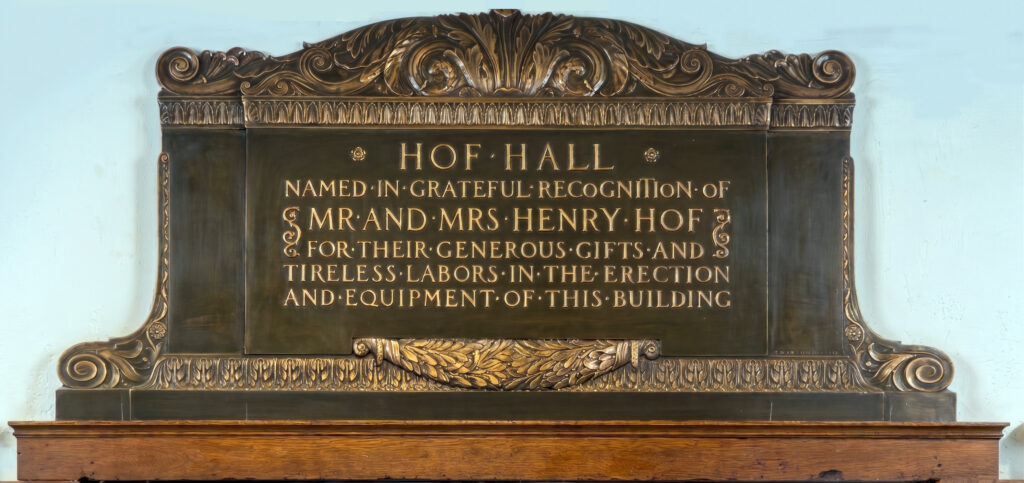
Edith and Theodore Roosevelt also shared close personal friendships within the Gardens, notably with Lillian and Henry Hof. The Hofs were prominent local philanthropists who were members of the Church-in-the-Gardens. They led the monumental efforts within the church and the wider community to build a dedicated Community House—an institution owned by the church but explicitly built and designated for the use of the entire Forest Hills community.
Brass medallion plaque above the Community House Auditorium entrance, which was named Hof Hall in honor of Lillian and Henry Hof.
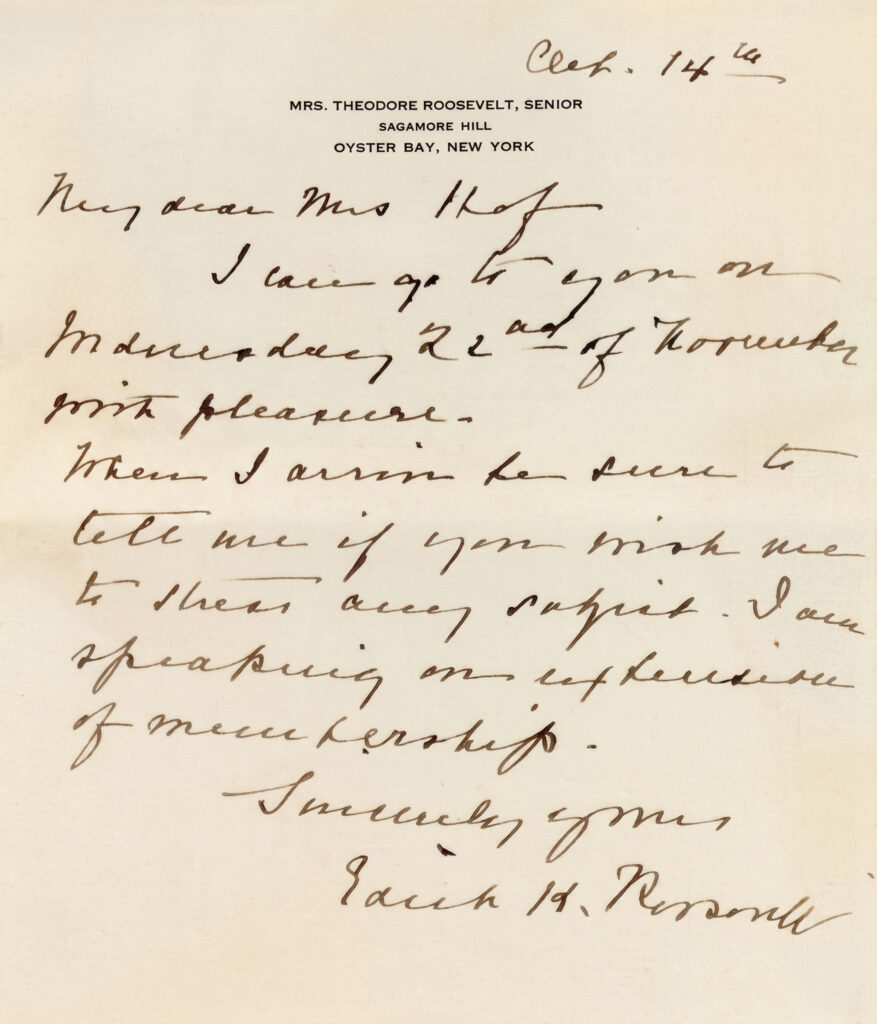
The Hofs and the Roosevelts had first met as summer neighbors near Oyster Bay—the Roosevelts at Sagamore Hill and the Hofs on Center Island, just across the bay as the crow flies by boat and eight miles by car. Both Edith Roosevelt and Lillian Hof were deeply committed to civic duty, remaining highly active in the Red Cross (and their needle point club) long before the United States formally entered the Great War.
Text from script from above October 14th letter from Edith Roosevelt to Lillian Hof: “I can go to you on Wednesday, 22nd of November with pleasure. When I arrive be sure to tell me if you wish me to stress any subject. I am speaking on extension of membership.”
Furthermore, the Roosevelts already knew and liked the Gardens. The May 2, 1916 Bulletin proudly reported:
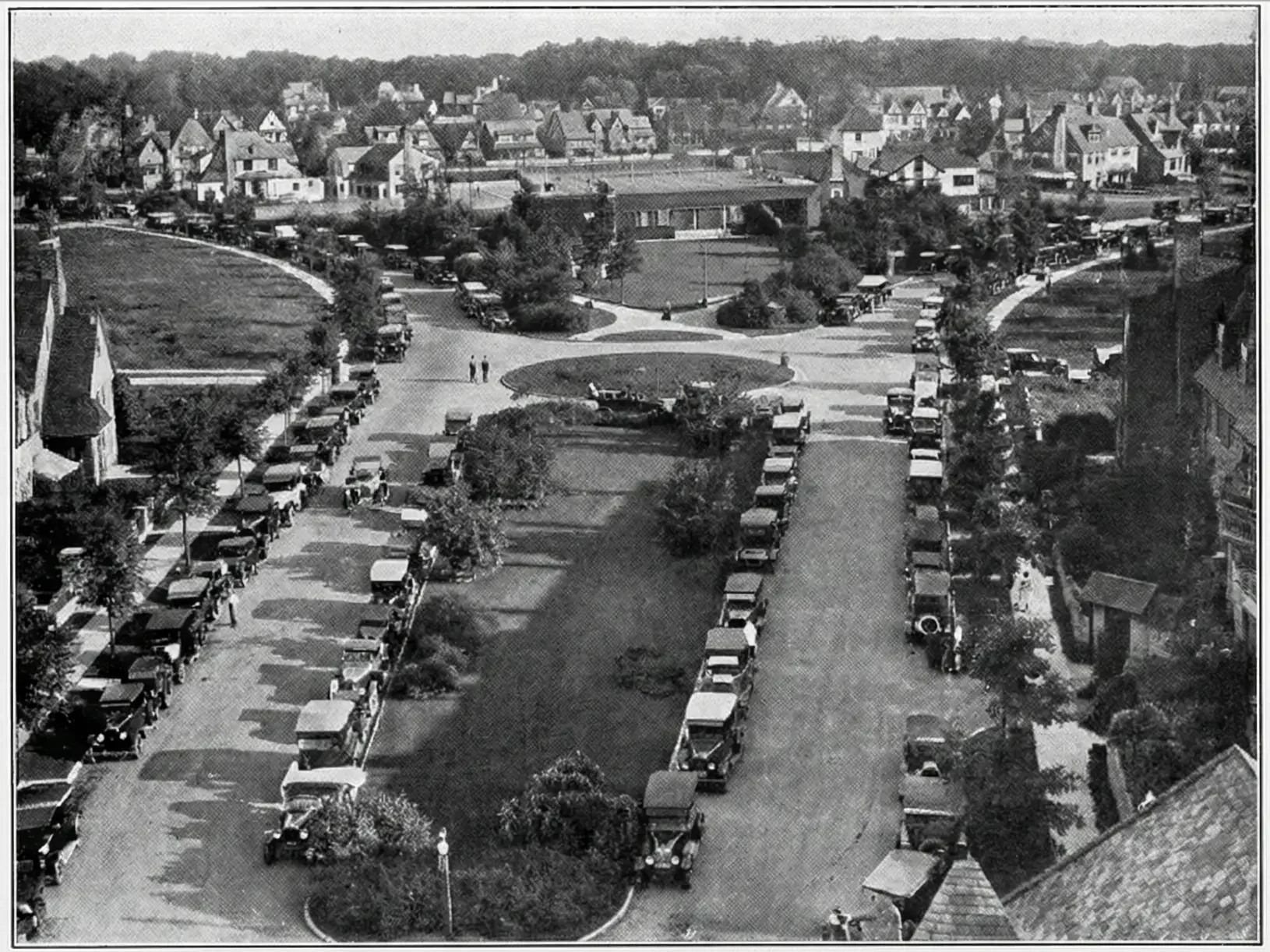
“Theodore Roosevelt attends the National Tennis Championship matches at The West Side Tennis Club on Labor Day. The event drew record-breaking crowds of 8,000 – 12,000 spectators daily, and over 2,500 cars were parked in the Gardens.”
A bird’s-eye view from the Gardens Bulletin showing parked cars along Greenway Terrace during the 1916 Tennis Championships.
An “Invitation” or a Lobbying Feat?
While the personal connection between Bishop Burgess and TR was certainly a prime mover, the effort to bring Roosevelt to the Gardens was less a standard invitation and more a masterclass in local lobbying.
The 1958 history of St. Luke’s, This Parish Under God, notes that it was at the Bishop’s personal invitation that Roosevelt delivered what was generally regarded as his finest wartime speech—a stirring patriotic plea for preparedness that became known as his “100% American” speech. One Hundred Percent American Speech
However, the Gardens Bulletin of June 16, 1917, reveals that a Fourth of July Celebration Committee of about 50 local men formally voted on and issued the invitation on June 7th. Naturally, Mr. Demarest served as the Chairman of the Entertainment and Program Subcommittee tasked with securing the speaker.
Why did TR accept this specific invitation out of 500 options, especially with such a short turnaround? The Theodore Roosevelt Center provides the crucial historical context:
“Theodore Roosevelt initially refused invitations to speak on Independence Day in 1917 because he was deeply dejected and politically furious over President Woodrow Wilson’s refusal to let him lead a volunteer army division in World War I. He ultimately changed his mind and agreed to speak at Forest Hills Gardens because the newly built community aligned with his social ideals, and its local rifle club offered aperfect backdrop for his urgent wartime message.“
The Big Day: July 4, 1917
Because Forest Hills Gardens had been lavishly celebrating Independence Day since 1914, the community already had a finely tuned “usual schedule” into which Roosevelt seamlessly fit.
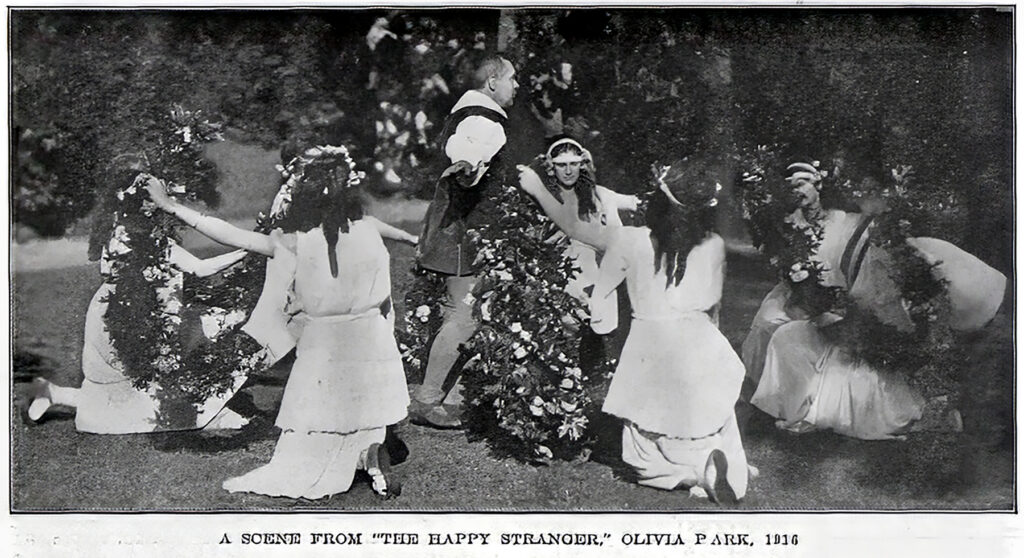
His speech was set for 11:00 AM, to be followed by the dedication of a new bronze base for the flagpole and a formal review of the Rifle Club. The afternoon featured traditional children’s games, tennis matches between the “Inns” and the “Outs,” and a unique “sylvan entertainment” in Olivia Park.
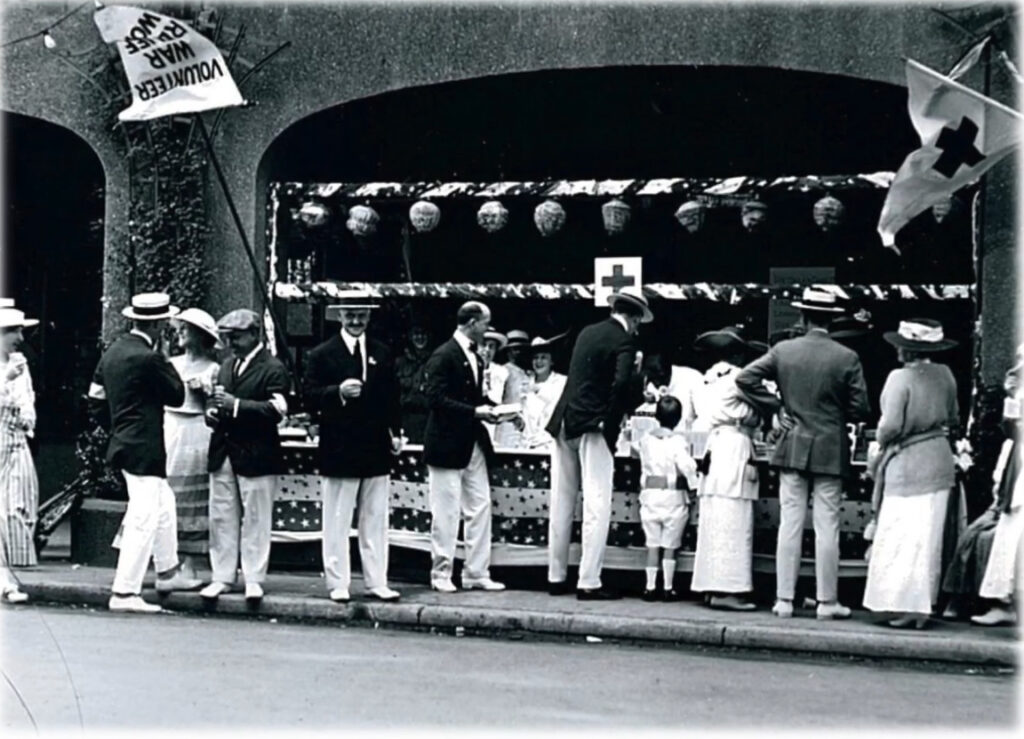
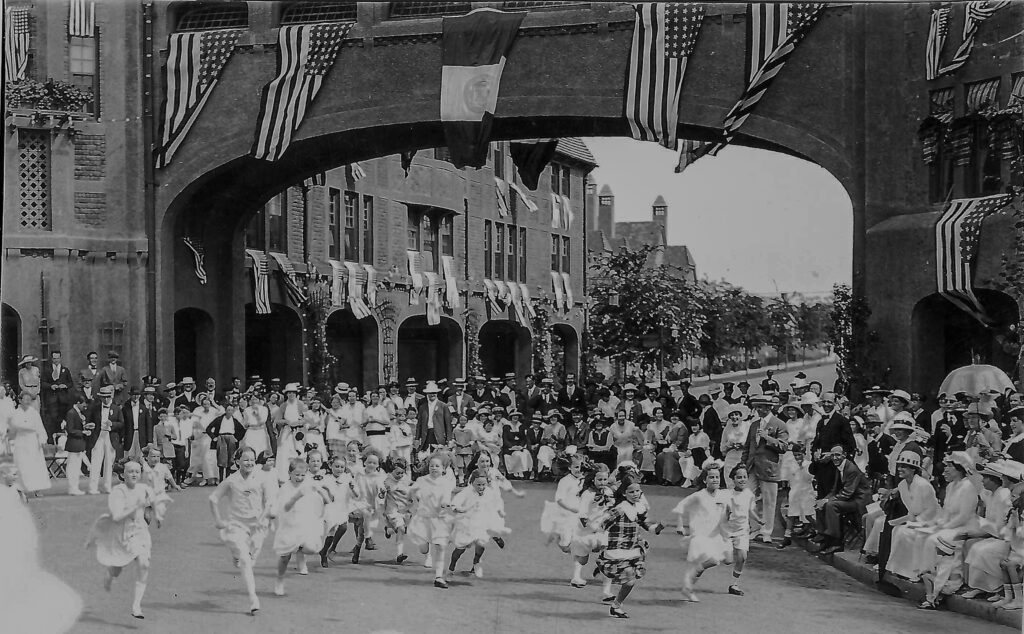
Red Cross Booth, 1916Girls racing in Station Square, 1916
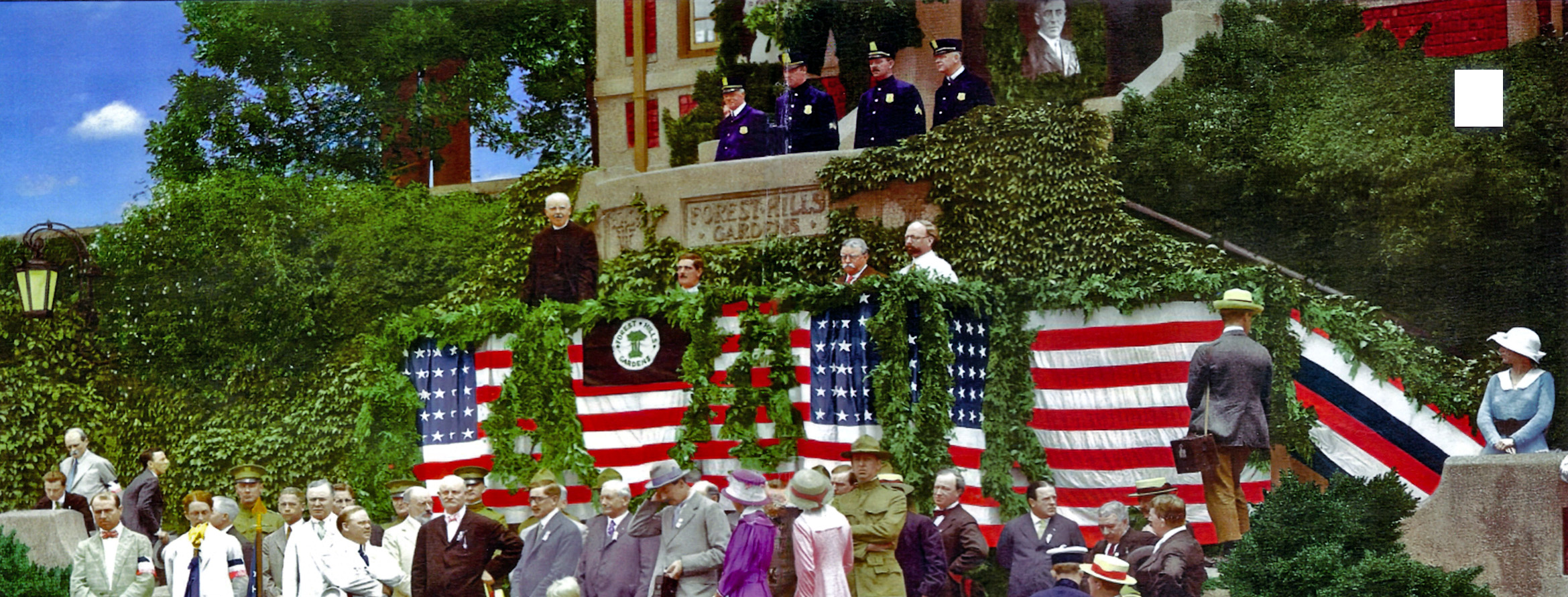
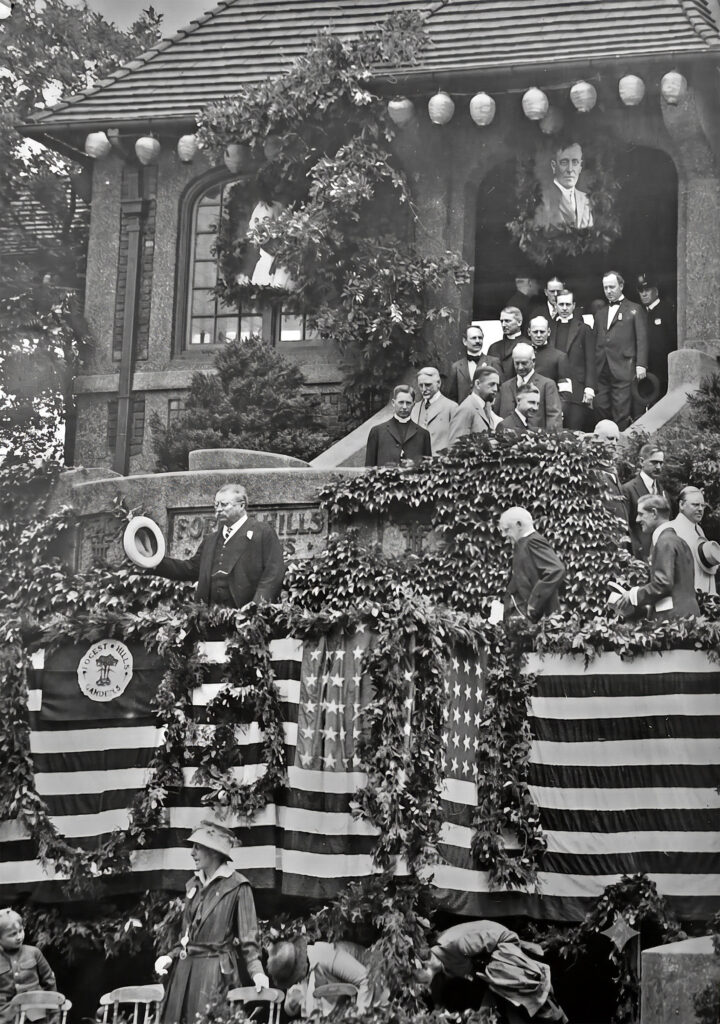
TR arrived in Station Square via the railroad, heading west from Garden City. Because the train pulled up on the “Austin Street side” of the platform, a temporary gangway was put into place directly over the eastbound track. This allowed TR and his entourage to step straight from the train platform onto the iconic Station Square balcony.
In this fabulous archival silent film, you can watch the historic moment unfold as the white-haired Bishop Burgess introduces Colonel Roosevelt to the cheering crowds below. The film runs approximately five minutes long and is compiled slightly out of chronological order.
Grosvenor Atterbury and John Demarest are among the dignitaries descending the stairs behind TR.
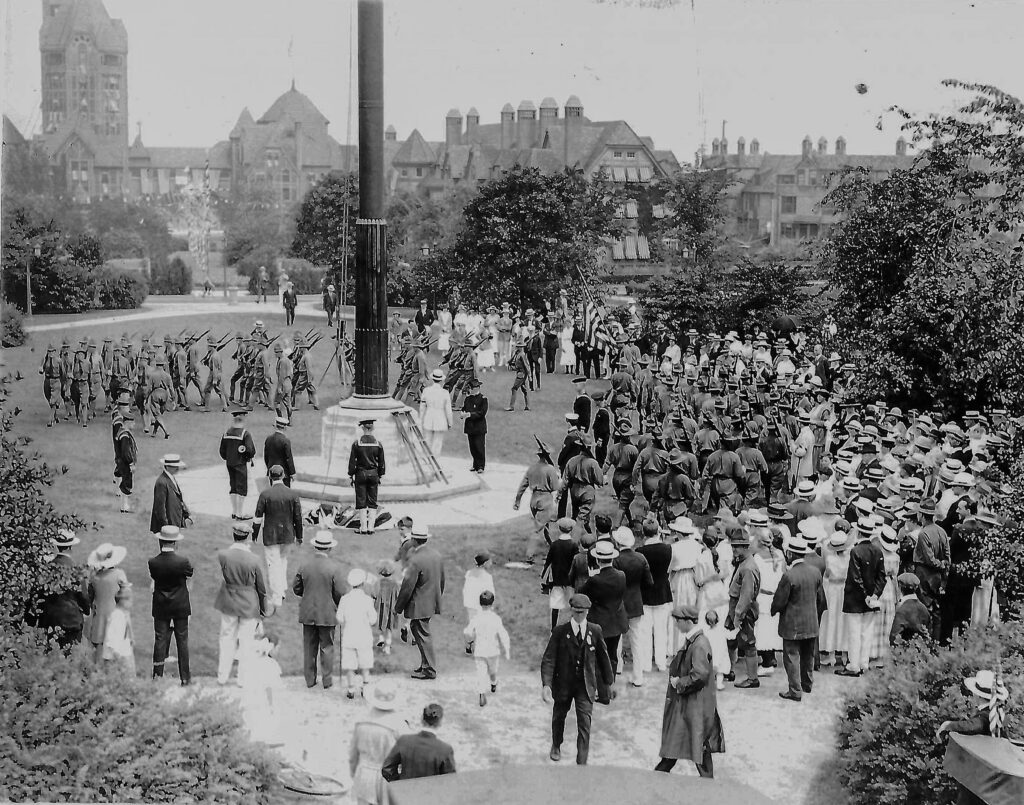
After delivering his electrifying address to a packed crowd of an astonishing 2,000 to 3,000 people, TR reviewed the Forest Hills Rifle Club in Station Square, followed by the Rainbow Division along Greenway Terrace and on Flagpole Green.
Raising of the Flag at Flag Pole Green
The troops that proudly marched that day belonged to the Rifle Club and famed Rainbow Division, who were stationed nearby at Fort Mills (in the area now known as Garden City). Demonstrating the community’s deep wartime commitment, Gardens residents generously hosted these soldiers in their private homes during their visit, and continuously sent vital provisions—including custom clothing, food, and medical bandages—overseas throughout the war.
Local oral history tells us that before leaving the Gardens TR enjoyed a celebratory luncheon at 35/37 Greenway Terrace. The historic lodge is on the eastern end of the pebbled and brick row houses as you walk up the Terrace from the right side of the square.
We may not have a written record of the luncheon attendees, but we do have a remarkable visual record of the day. It was John M. Demarest himself who purchased the rare, original silent film of the festivities. He donated it to the Roosevelt Memorial Association which in turn transferred it to the Library of Congress, saving this extraordinary piece of Forest Hills Gardens history for posterity.
Sources & Acknowledgments
Much of the historical data featured in this article is preserved in the archives of the Forest Hills Gardens Foundation. Principal sources include the Forest Hills Gardens Bulletins (circulated biweekly from September 25, 1915, to December 13, 1925) and the historical volume This Parish Under God (St. Luke’s Church, 1958), which is available for viewing in hard copy by appointment with the Foundation’s archives.
Special thanks to Susanna and Rob Hof for their invaluable assistance, research support, and contributions to uncovering this history.
Image Identification Note: In the color image at the top of the page, Grosvenor Atterbury is seated between Theodore Roosevelt and the standing Bishop Frederick Burgess. Seated directly to the right of Theodore Roosevelt is John Demarest.
Your donation will help us in our mission to preserve the history and legacy of Forest Hills Gardens!
Thank you from the Board of the Forest Hills Gardens Foundation (aka Taxpayers Association). As we a not-for-profit service 501(c)3 service organization, your donation is tax deductible.