



Richard Buckminster Fuller Jr.
The Comprehensive Design Scientist and the Architectural Nexus of Forest Hills Gardens
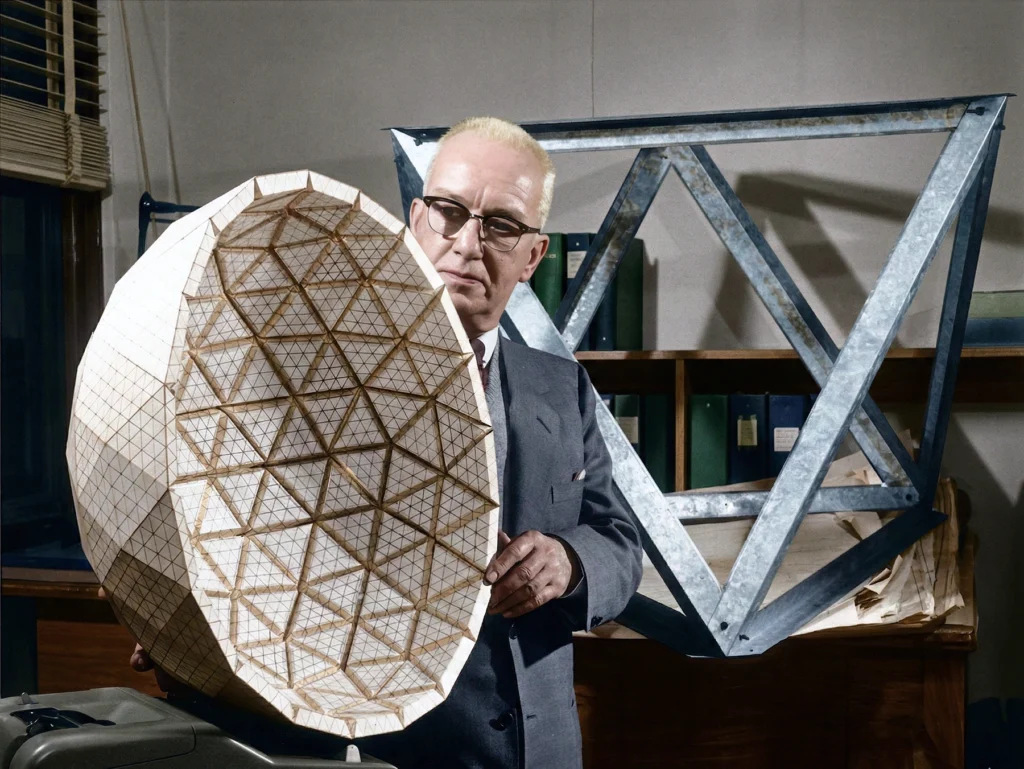
Richard Buckminster Fuller Jr. (1895–1983) described himself as a “comprehensive anticipatory design scientist,” which captures both his ambition and his method.¹ Instead of a conventional architectural career, he led a sustained experiment in how one individual might improve humanity’s chances for survival through design.¹ While historians often divide his life into early struggle, mid-century geodesic triumph, and late philosophical prominence, a closer examination reveals that Forest Hills, Queens—specifically Forest Hills Gardens—nurtured his architectural thought and professional identity.¹
Born in Milton, Massachusetts, Fuller grew up in a family steeped in New England intellectual independence.¹ A distant relative of Margaret Fuller, he inherited a suspicion of convention and a belief in individual moral responsibility.² His early visual impairment—he was severely farsighted until age four—led him to think in large patterns rather than fine details. This trait later defined his systems-based philosophy.⁴ After brief and unsuccessful stints at Harvard University and formative service in the United States Navy during World War I, Fuller married Anne Hewlett in 1917.¹ This marriage gave him entry into a world that would change his life: her father’s architectural circle in Forest Hills.²
Anne’s father, architect and muralist James Monroe Hewlett, designed houses in Forest Hills Gardens.⁹ A graduate of Columbia University and the École des Beaux-Arts, Hewlett represented the height of traditional architectural culture.⁹
Forest Hills Gardens itself was an idealistic experiment in controlled urban beauty; its curving streets, brick façades, and cohesive aesthetic offered a refuge from Manhattan’s commercial chaos.³ In this orderly, almost storybook setting, Fuller absorbed the language of architecture at its most refined. Yet he also saw its limitations. The handcrafted house, no matter how beautiful, struck him as inefficient in an age of airplanes, assembly lines, and global logistics.¹²
The Forest Arms: 1 Ascan Avenue
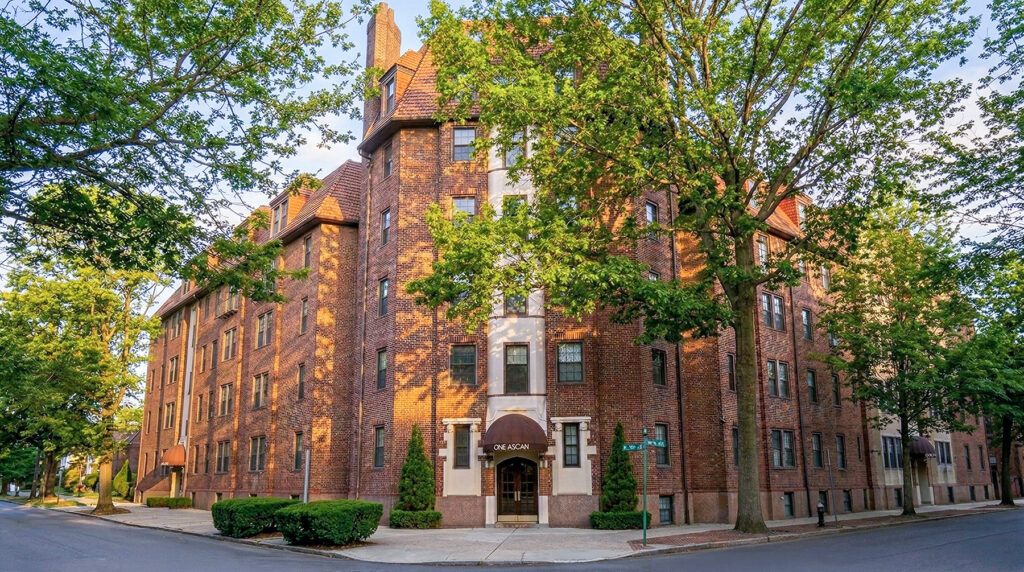
By the early 1920s, Fuller was living nearby at the Forest Arms Apartments, 1 Ascan Avenue, a prominent seven-story building completed in 1922.³ The apartment placed him in the heart of a progressive yet tradition-bound community of professionals and artists.³ From his windows, he could observe Grosvenor Atterbury’s innovations in standardized construction—early uses of precast concrete elements that hinted at mass production.¹⁰ Forest Hills Gardens influenced Fuller’s belief that housing could be “manufactured” rather than “built.”¹
The Stockade Building System (Queens, 1922–1927)
In 1922, Fuller and Hewlett co-founded the Stockade Building System,⁴ based on Hewlett’s compressed fiber building blocks (later known as Soundex).⁶ The company sought to industrialize home construction.⁶ Operating in Queens, Fuller supervised factory production and oversaw the construction of approximately 240 houses along the East Coast.² The venture marked his first full-scale attempt to apply industrial efficiency to domestic architecture, or what he would later call “design science.”⁵ Yet tensions mounted. Fuller’s experimental ambitions outpaced his financial discipline, and in 1927, he was forced out of the company by stockholders.²
This failure proved transformative; it severed him from conventional building practice and propelled him toward a radically new architectural philosophy.² Where Forest Hills Gardens homes were rooted in land and tradition, Fuller’s Dymaxion vision floated, literally and philosophically, free from convention.¹² The contrast is telling: the Gardens embodied early 20th-century faith in craftsmanship and aesthetic order.² Fuller sought efficiency, lightness, and scalability.¹ In many ways, the neighborhood was the foil that clarified his life’s mission.¹⁰
Return to Queens: Geodesics Incorporated
In 1949, at the dawn of his geodesic revolution, Fuller returned to Queens, where he established Geodesics Incorporated, an engineering and design firm, in Forest Hills.¹⁹ He managed projects that would gain international prominence, including military radar domes associated with the Distant Early Warning Line⁵ and experimental lightweight structures.²² Forest Hills served as a stable operational base, provided architectural essentials (such as proportion, order, and human scale),³ and acted as a calm residential counterpoint to his increasingly public intellectual life. Fuller’s ideas grew (Operating Manual for Spaceship Earth, the Dymaxion Map, and the Geodesic Dome)¹¹ while the disciplined harmony of Forest Hills Gardens offered a grounding environment from which he could imagine redesigning the world. As a result, Forest Hills Gardens functioned as operational headquarters during one of the most innovative architectural breakthroughs of the 20th century.
The Importance of Forest Hills Gardens
In Forest Hills Gardens, Fuller lived within one of America’s most carefully planned communities—an embodiment of early 20th-century optimism about how environment shapes society.³ That ethos resonated deeply with him. But where the Gardens sought harmony through craftsmanship and historical style, Fuller sought it through mathematics, industry, and global systems.¹
The tension between those visions—Tudor brick and tensile steel, garden suburb and lightweight, mass-produced house—became the generative friction of his career.
When Fuller later urged humanity to see Earth as a single, interconnected vessel, he was expanding a lesson first conceived in Forest Hills Gardens: design is destiny, and the built environment quietly instructs the future.¹
Forest Hills Gardens did not merely house Buckminster Fuller. It cultivated him.³
Learn more about R. Buckminster Fuller, and notable residents behind Tennis View Apartments : https://foresthillsgardensfoundation.org/article/the-notables-behind-tennis-view-apartments/
Sources:
[1] SIEDEN, L S. Buckminster Fuller’s Universe: His Life and Work[EB/OL]. (1989)[2026-02-26]. https://archive.org/details/buckminsterfulle00sied.
[2] ZUNG, T T K. Anthology of Tomorrow: Buckminster Fuller[EB/OL]. (2001)[2026-02-26]. https://www.google.com/books/edition/Anthology_of_Tomorrow/6_0RDAAAQBAJ.
[3] FOREST HILLS GARDENS CORPORATION. History and Heritage of the Gardens[EB/OL]. (2025)[2026-02-26]. https://www.foresthillsgardensblog.com/history.
[4] FULLER, R B. Ideas and Integrities: A Spontaneous Autobiographical Disclosure[EB/OL]. (1963)[2026-02-26]. https://www.bfi.org/about-fuller/resources/books/ideas-and-integrities.
[5] PAWLEY, M. Buckminster Fuller: Design Heroes[EB/OL]. (1990)[2026-02-26]. https://www.architecture.com/knowledge-and-resources/resources-landing-page/buckminster-fuller.
[6] ARCHITECTURAL RECORD. The Stockade Building System[EB/OL]. (1922)[2026-02-26]. https://www.architecturalrecord.com/archives.
[9] COLUMBIA UNIVERSITY. James Monroe Hewlett: Alumni Profiles[EB/OL]. (2024)[2026-02-26]. https://arch.columbia.edu/history/hewlett.
[10] FOREST HILLS GARDENS FOUNDATION. Grosvenor Atterbury and the Forest Hills Gardens Experiment[EB/OL]. (2026)[2026-02-26]. https://www.fhgfoundation.org/history/atterbury.
[11] BUCKMINSTER FULLER INSTITUTE. Operating Manual for Spaceship Earth[EB/OL]. (1969)[2026-02-26]. https://www.bfi.org/about-fuller/big-ideas/operating-manual-spaceship-earth.
[12] WIKIPEDIA CONTRIBUTORS. Dymaxion House[EB/OL]. Wikipedia, The Free Encyclopedia, (2026-01-15)[2026-02-26]. https://en.wikipedia.org/wiki/Dymaxion_house.