


Fred Stone and the Theatrical Soul of Forest Hills Gardens
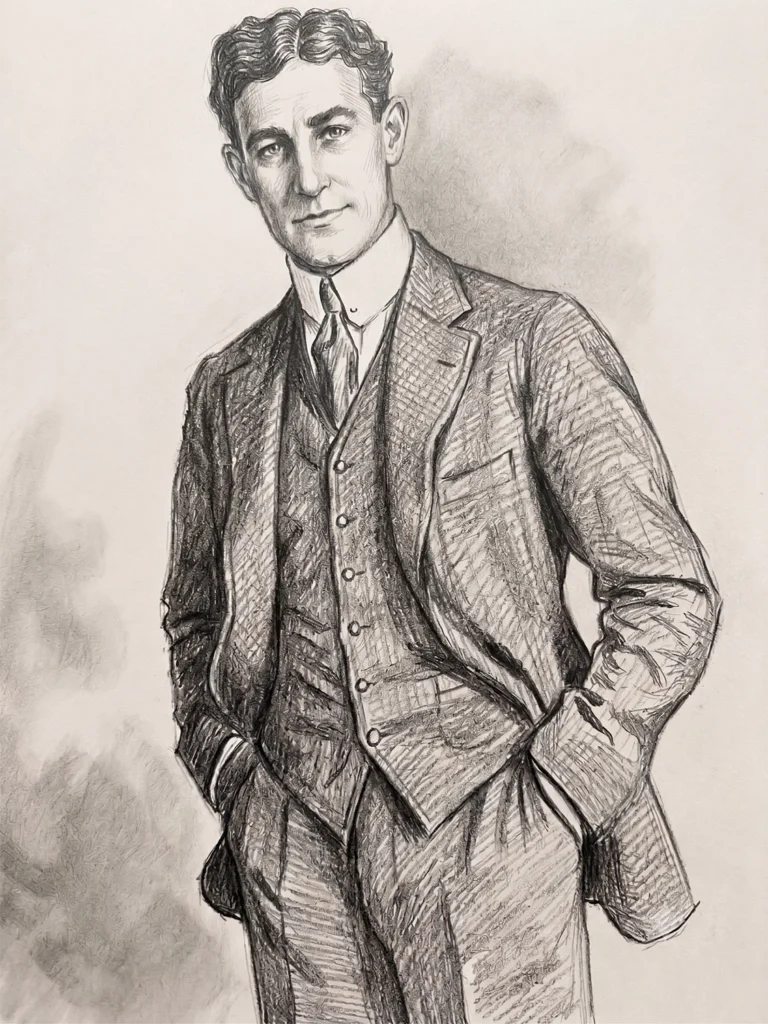
Fred Stone stands as one of the great transitional figures in American entertainment history, a performer who rose from the rough improvisational culture of the western frontier to become one of Broadway’s most celebrated stars and one of the defining theatrical personalities of the early twentieth century.¹⁰ His extraordinary career encompassed vaudeville, musical comedy, silent film, labor activism, and cultural celebrity. Yet beyond the bright marquees of Broadway and the mythology of The Wizard of Oz, Stone’s life became deeply intertwined with another distinctly American experiment: Forest Hills Gardens, the planned garden suburb in Queens that transformed not only where he lived, but how he lived.⁵
Forest Hills Gardens gave Stone something that the itinerant theatrical world never could—permanence, domesticity, artistic community, and social legitimacy. The neighborhood became both sanctuary and stage: a place where one of America’s most famous entertainers could evolve from touring acrobat into a civic leader, suburban patriarch, and cultural institution.²
Born Fred Andrew Stone on August 19, 1873, in Valmont, Colorado, Stone grew up amid the instability and hardship of the post–Civil War American frontier.¹² His family moved repeatedly across Kansas prairie settlements including Dodge City and Garden City, where life revolved around survival, agricultural labor, and constant movement.² The family often lived in sod houses on the open prairie, conditions that demanded physical endurance and self-reliance.³ These early surroundings would profoundly shape Stone’s theatrical identity. The elasticity, athleticism, and comic physicality that later made him internationally famous originated not in conservatories or elite drama schools, but in the improvisational entertainments of frontier America.³
As a teenager, Stone gravitated toward traveling circuses, medicine shows, minstrel companies, and wild west exhibitions that periodically passed through the isolated prairie towns.³ Fascinated by acrobats and performers, he taught himself tightrope walking and highly physical comic dancing, developing an eccentric style that distinguished him from more traditional vaudeville comedians.³ Alongside his brother Ed Stone, he toured relentlessly through saloons, variety houses, and makeshift theaters across the American West.³ These years were grueling but formative; Stone learned to command audiences through movement, agility, and charisma rather than refined dramatic technique.³
The turning point in his career came in 1895 when he partnered with David C. Montgomery.³ Over the next twenty-two years, Montgomery and Stone became one of the most successful comedy duos in American theater history.³ Their energetic blend of slapstick, acrobatics, dance, and musical comedy propelled them from regional vaudeville circuits to Broadway stardom.³ Their Broadway breakthrough came with The Girl from Up There in 1901,¹⁰ but their greatest triumph arrived shortly afterward in the stage adaptation of The Wonderful Wizard of Oz.⁹
Premiering in Chicago in 1902 before moving to Broadway in 1903, The Wizard of Oz became a theatrical phenomenon.⁹ Stone originated the role of the Scarecrow, while Montgomery played the Tin Woodman.⁹ Stone’s Scarecrow—elastic, acrobatic, naïve, and endlessly lovable—captivated audiences and critics alike.⁹ Drawing directly from the physical techniques he had developed during his frontier years, Stone transformed the Scarecrow into one of the most iconic comic performances of the era.³ His portrayal established a template for physical comedy that later influenced performers such as Ray Bolger, who openly acknowledged Stone’s influence on his own famous Scarecrow performance in the 1939 film adaptation.²
Following the success of The Wizard of Oz, Montgomery and Stone dominated Broadway through productions such as The Red Mill (1906), The Old Town (1909), and Chin-Chin (1914).⁹ Their popularity made Stone one of the highest-paid entertainers in America.¹¹ Yet despite immense fame and wealth, Stone never entirely abandoned the populist instincts formed during his years on the road. He became deeply involved in labor activism within the theatrical profession, serving as a founding member of the White Rats of America, an early vaudeville performers’ union that laid groundwork for modern performers’ protections.¹⁰
As Stone’s professional success soared, his personal life underwent a parallel transformation. Seeking refuge from the exhausting instability of touring life and the frenetic pace of Manhattan theater culture, Stone settled in Forest Hills Gardens, the meticulously planned Queens enclave developed according to the principles of the Garden City movement.⁵
Forest Hills Gardens was unlike any ordinary suburb. Conceived in 1909 by philanthropist Margaret Olivia Slocum Sage and designed by landscape architect Frederick Law Olmsted Jr. and architect Grosvenor Atterbury, the community sought to combine urban sophistication with the tranquility and order of an English village.⁵ Curving roads, carefully controlled architecture, brick plazas, landscaped greens, and strict design covenants created an atmosphere of aesthetic harmony and social exclusivity.⁴
For Stone, the Gardens represented a profound personal reinvention. The actor who had once traveled in wagons across the Kansas prairie now entered one of America’s most architecturally refined planned communities. Yet Forest Hills Gardens was more than a symbol of wealth; it offered Stone stability, artistic fellowship, and a place where performance and domestic life could merge seamlessly.²
Stone initially lived at 50 Olive Place and later at 5 Russell Place before establishing his permanent residence at 150 Greenway North around 1917.⁷ This Tudor Revival estate was designed by Atterbury and architect John Almy Tompkins II, one of the principal designers responsible for the visual identity of Forest Hills Gardens.¹⁵ The house embodied the architectural ideals of the Gardens while also reflecting Stone’s theatrical identity. Externally, it conformed to the neighborhood’s disciplined Tudor aesthetic. Internally, however, it functioned as a creative headquarters for an entertainment dynasty.²
Most notably, Stone transformed the basement into a private rehearsal theater where he, his daughters, and collaborators practiced dance routines, songs, and productions away from Broadway scrutiny.² Adjacent rooms housed an extensive archive of costumes and theatrical memorabilia from his legendary career.² The house therefore became more than a residence—it became a laboratory for artistic production embedded within suburban domestic life.
Forest Hills Gardens profoundly shaped Stone’s family life as well. He and his wife, actress Allene Crater, raised their daughters Dorothy, Paula, and Carol within the sheltered, highly structured environment of the Gardens.² The children attended the prestigious Kew-Forest School, while simultaneously training in the family’s basement theater.¹⁹ The Gardens allowed Stone to create something unusual for the theatrical world of the era: a stable, multigenerational artistic household rooted in one community rather than dispersed across touring circuits.²
His eldest daughter, Dorothy Stone, eventually became his professional stage partner, debuting alongside him in Stepping Stones (1923).² The family’s integration of home life and theatrical work reflected the broader ideals of Forest Hills Gardens itself—a belief that environment could cultivate healthy, harmonious, culturally enriched living.⁵
Stone’s relationship to the Gardens extended far beyond private residence. Unlike many celebrities who remained socially isolated, he became deeply engaged in civic and cultural life within the neighborhood.² He participated enthusiastically in local events, particularly the elaborate Fourth of July celebrations held in Station Square and Olivia Park.¹⁶ During the 1920 festivities, Stone served on the Committee on Children’s Games and personally entertained neighborhood children during the event’s finale.¹⁸
The 1924 celebration demonstrated how fully Stone had become integrated into community life. He performed songs from Peter Pan alongside Dorothy Stone in Olivia Park while his younger daughters also participated in theatrical performances with neighborhood children.¹⁷ These events blurred the boundary between celebrity performance and local civic tradition. Stone effectively brought Broadway into the communal spaces of Forest Hills Gardens, transforming neighborhood gatherings into theatrical spectacles while simultaneously humanizing himself among neighbors.¹⁷
Stone also contributed financially to local improvement initiatives, including anti-mosquito campaigns intended to improve public health throughout the Gardens.¹⁸ His civic participation reflected the broader ethos of Forest Hills Gardens itself: a carefully designed environment where culture, architecture, and community engagement reinforced one another.⁵
The Gardens additionally became a social nexus for America’s entertainment elite. Stone’s closest friend was Will Rogers, who lived nearby in Kew Gardens.¹³ Their friendship dated back to their early vaudeville days and became deeply familial; Rogers even named his son Fred Stone Rogers after him.³ Stone’s home hosted celebrities including Annie Oakley, Douglas Fairbanks, and Tom Mix.¹³ Through Stone and his circle, Forest Hills Gardens became connected to a larger network of theatrical and cultural power that stretched from Broadway to Hollywood.
In 1928, Stone’s idyllic life in the Gardens nearly came to an end after a catastrophic airplane crash crushed his legs and left doctors convinced he would never walk again.² At age fifty-five, the prognosis threatened to destroy the physical artistry that defined his career.² Retreating to his home at 150 Greenway North, Stone undertook a brutal rehabilitation process.² In an extraordinary display of determination, he eventually returned triumphantly to the stage in 1930, defying all medical expectations.² The Gardens once again served as sanctuary—not merely architectural refuge, but a place of recovery and reinvention.
As vaudeville declined and Hollywood rose, Stone transitioned successfully into film, appearing in productions such as Alice Adams (1935), The Trail of the Lonesome Pine (1936), and The Westerner (1940).⁸ In 1945 he published his autobiography Rolling Stone, recounting his journey from prairie performer to theatrical legend.¹ That same year he made his final New York stage appearance in You Can’t Take It With You.¹⁰
By 1946, Stone left Forest Hills Gardens after nearly three decades there.¹⁶ Yet the neighborhood remained central to his legacy. Forest Hills Gardens had provided the framework within which Stone transformed from a transient vaudevillian into an American cultural patriarch. It offered him architectural permanence, civic identity, and an environment where art and domestic life could coexist.¹
When Fred Stone passed away in 1959, he was remembered as one of the foundational stars of modern American entertainment. Yet his legacy survives far beyond theater history and Hollywood lore. It endures physically within the Tudor architecture, brick pathways, and communal spaces of Forest Hills Gardens—a neighborhood that didn’t merely shelter him, but fundamentally shaped the most meaningful chapters of his life.
Sources
1] Fred Stone, Rolling Stone (New York: Whittlesey House, 1945), 24–38.
[2] For detailed accounts of Stone’s family life, recovery at Forest Hills, and theatrical legacy, see “Fred Stone, Actor, 85, Dies on Coast,” New York Times, March 7, 1959.
[3] Armond Fields, Fred Stone: Circus Performer and Musical Comedy Star (Jefferson, NC: McFarland & Company, 2002), 12–29, 45–53.
[4] Susan Klaus, A Modern Arcadia: Frederick Law Olmsted Jr. and the Plan for Forest Hills Gardens (Amherst: University of Massachusetts Press, 2002), 48–56.
[5] Architectural Record Company, “Forest Hills Gardens: A Study and Demonstration of American Suburb Planning,” Architectural Record 31, no. 2 (February 1912): 113–121.
[6] Note: Citation number 6 was omitted in the original text manuscript.
[7] New York City Bureau of Holdings, Queens County Property Assessment and Transfer Records, 1915–1920 (Long Island City: Queens Borough Public Library, Westchester Division), microfilm reel 14.
[8] Terry Ramsaye, A Million and One Nights: A History of the Motion Picture (New York: Simon & Schuster, 1926), 402–405.
[9] L. Frank Baum and Julian Mitchell, The Wizard of Oz: A Musical Extravaganza (Chicago: Chicago Opera House Playbill, 1902); see also Broadway production opening programs, Majestic Theatre, January 1903.
[10] Brooks Atkinson, Broadway (New York: Macmillan, 1970), 114–118.
[11] Gerald Bordman, American Musical Theatre: A Chronicle, 4th ed. (New York: Oxford University Press, 2010), 210–214.
[12] United States Census Bureau, “Tenth Census of the United States, 1880: Valmont, Boulder County, Colorado,” Digital image, s.v. “Fred A. Stone,” lines 14–18.
[13] Ben Yagoda, Will Rogers: A Biography (Norman: University of Oklahoma Press, 1993), 182–185.
[14] Note: Citation number 14 was omitted in the original text manuscript.
[15] “The Work of Grosvenor Atterbury,” The American Architect 102, no. 1918 (September 25, 1912): 105–112.
[16] Forest Hills Gardens Celebrations Committee, A History of Fourth of July Celebrations in Forest Hills Gardens, 1915–1930 (New York: Forest Hills Gardens Association, 1931), 14–22.
[17] “Forest Hills Celebrates: Fred Stone and Daughter Dorothy Entertain Neighbors in Olivia Park,” The Daily Star (Queens), July 5, 1924, 3.
[18] “Gardens Association Minutes: Civic Improvements and Health Campaigns,” The Forest Hills Bulletin 5, no. 12 (August 1920): 1–2.
[19] Kew-Forest School Alumni Association, The Kew-Forest School: The First Fifty Years, 1918–1968 (Forest Hills, NY: Privately Printed, 1968), 8–11.