



Raymond Vahan Damadian
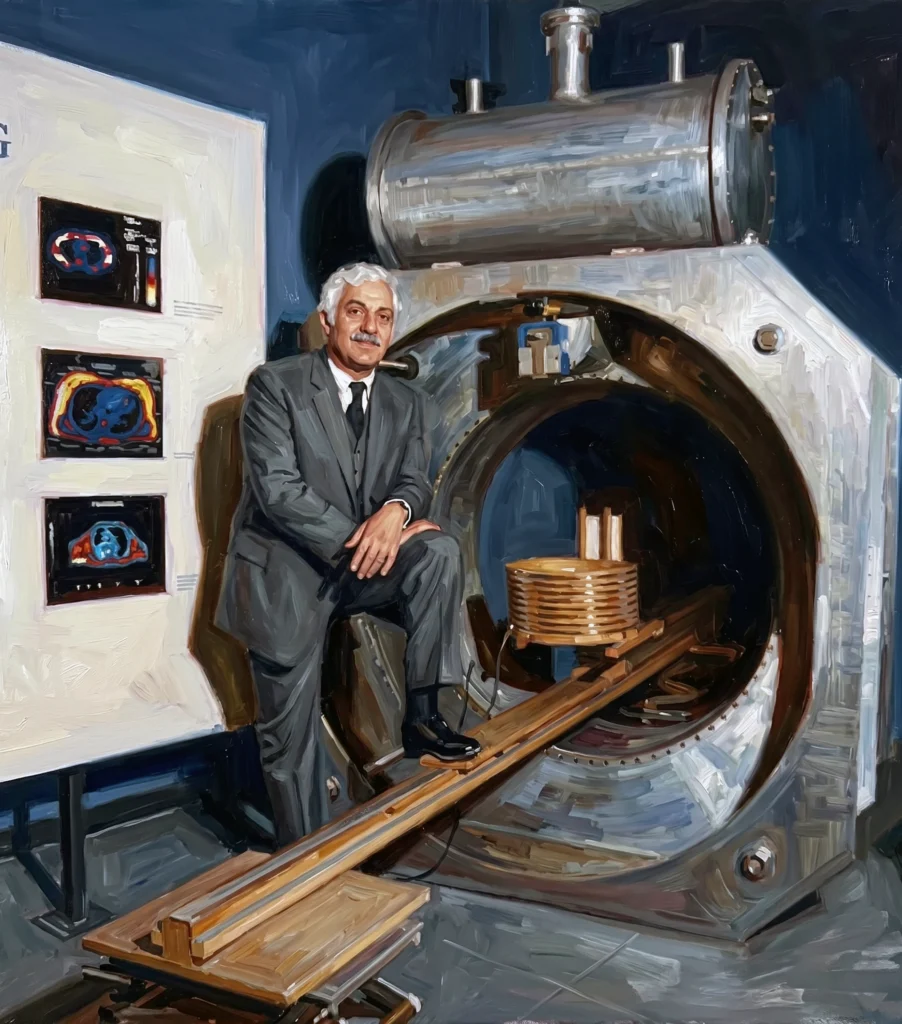
Raymond Vahan Damadian (March 16, 1936 – August 3, 2022) was an American physician, medical researcher, and inventor. He is best known for his pioneering work in magnetic resonance imaging (MRI), a technology that revolutionized diagnostic medicine. Damadian conducted the first full-body scan of a human being in 1977 to diagnose cancer.
Early Life and Connection to Forest Hills Gardens
Damadian was born in New York to Armenian-American parents, Vahan and Odette Damadian. He spent his childhood in Forest Hills, deeply connected to the local educational institutions of Forest Hills Gardens.
- Primary Education in the Gardens: He attended P.S. 101 (The School in the Gardens), a historic school located in the heart of Forest Hills Gardens, graduating in 1949.
- High School: He continued his education at Forest Hills High School. During his time there, the school was renowned for its science program. Damadian later credited his high school mathematics teacher, Wally Manheim, with making a significant impression on him.
- Musical Roots: A child prodigy in music as well as science, he studied violin at the Juilliard School for eight years while living in the neighborhood.
His academic excellence at Forest Hills High School led to him winning a prestigious Ford Foundation Scholarship at age 15, which allowed him to enter college early.
Education and Medical Training
Damadian earned a bachelor’s degree in mathematics from the University of Wisconsin–Madison in 1956 and a medical degree from the Albert Einstein College of Medicine in the Bronx in 1960. He later served as a fellow in nephrology at Washington University School of Medicine and in biophysics at Harvard University.
The Invention of the MRI
In 1971, while a professor at SUNY Downstate Medical Center in Brooklyn, Damadian published a seminal paper in the journal Science. He discovered that tumors and normal tissue could be distinguished in vivo by nuclear magnetic resonance (NMR) because of their different water relaxation times. This discovery laid the scientific foundation for the MRI.
He spurred the creation of the first MRI machine, which he named “Indomitable.” On July 3, 1977, Damadian and his team performed the first human body scan on his assistant, Larry Minkoff, as Damadian himself was too large to fit in the prototype.
Fonar Corporation and Later Career
In 1978, Damadian founded Fonar Corporation (Field FOcused Nuclear mAgnetic Resonance) to manufacture MRI scanners. Fonar produced the world’s first commercial MRI machine in 1980. He spent much of his later career improving MRI technology, including the development of “Stand-Up” MRI machines to help patients with claustrophobia.
Awards and Controversy
Damadian received the National Medal of Technology in 1988 and was inducted into the National Inventors Hall of Fame in 1989. However, he was notably excluded from the 2003 Nobel Prize in Physiology or Medicine, which was awarded to Paul Lauterbur and Peter Mansfield for their work on MRI. This exclusion sparked significant controversy, with Damadian publicly arguing that his original discovery of the tissue relaxation differences was the prerequisite for their contributions.
Death
Raymond Damadian died on August 3, 2022, at his home in Woodbury, New York, at the age of 86.
Sources
- Fonar Corporation – Nobel Prize for MRI Imaging Denied to Raymond V. Damadian (PDF) (Detailed source regarding his attendance at P.S. 101 in Forest Hills Gardens and Forest Hills High School)https://www.fonar.com/pdf/NOBEL%20PRIZE%20FOR%20MRI%20DAMADIAN,%20GBK,%20CHEM%20EDUCATOR,%2019,%2019,73-90%20(MARCH%2021,%202014).pdf
- National Inventors Hall of Fame – Raymond Damadian: Magnetic Resonance Imaging (MRI)https://www.invent.org/inductees/raymond-v-damadian
- Lemelson-MIT Program – Raymond Damadian https://lemelson.mit.edu/resources/raymond-damadian
- Forest Hills Gardens Foundation – Famous Residents Archive https://foresthillsgardensfoundation.org/famous-residents/
- Radiopaedia – Raymond V Damadian https://radiopaedia.org/articles/raymond-v-damadian